
Turnkey Interiors
What Is Turnkey Interior Design? A Complete Guide for Homeowners
Turnkey interior design is a complete, end-to-end home interior service. One company handles design, material sourcing, civil and carpentry work, electrical and plumbing coordination, and final styling.
Candidscape editorial guide8 min read
Turnkey interior design is a complete, end-to-end home interior service. One company handles design, material sourcing, civil and carpentry work, electrical and plumbing coordination, and final styling, and hands you a fully finished, move-in-ready space at the end. You don’t manage separate vendors or track a dozen moving parts yourself; one team is accountable for the whole outcome. That’s the short version. The rest of this guide covers what’s actually included, how turnkey compares to hiring a designer or contractor separately, what the process looks like stage by stage, and how to tell if it’s the right fit for your home.
What Does “Turnkey” Actually Mean in Interior Design?
The word comes from construction and manufacturing, where a “turnkey” project meant a facility built and equipped to the point where the owner could simply turn a key and start operating it. In interior design, the same idea applies to your home: you hand over a brief and a budget, and you receive a completed, ready-to-live-in space, not a set of drawings, and not a half-finished site you still have to manage. It helps to see this against the two more fragmented ways people usually approach home interiors:
• Hiring a designer only. You get a concept, a floor plan, material and colour recommendations, but you still have to find and manage the carpenters, electricians, plumbers and painters who actually build it. If the site execution doesn’t match the drawing, that gap is now your problem to resolve.
• Hiring a contractor only. You get someone to execute, but design decisions, material selection and coordination between trades often fall back on you, or get made ad hoc on site without a designer’s oversight. Turnkey removes that split. One company owns both the design and the execution, so there’s no handoff where responsibility, or quality, can quietly get lost.
Key Aspects of a Turnkey Interior Design
A genuine turnkey service isn’t just “we’ll manage your vendors.” It typically has a few defining characteristics:
1. A single point of contact. One team, not a designer here and a contractor there, is accountable for the entire project, from the first drawing to the final handover.
2. Design validated before execution. Better turnkey providers test the design against the brief before construction starts, rather than discovering clashes or misalignments on site. At Candidscape, this is done digitally with AI, so what you approve on screen is what actually gets built.
3. Structured timelines and costing. Scope, materials, and schedule are defined upfront in a contract, not negotiated informally as the project goes along.
4. Coordinated trades under one roof. Carpentry, electrical, plumbing and civil work are sequenced by the same team that designed the space, instead of being managed independently by the homeowner.
5. One point of accountability at handover. If something needs correcting after handover, there’s no ambiguity about who’s responsible for it.
What’s Included in a Turnkey Interior Package?
While the exact scope varies by provider, a genuine turnkey interior package typically covers:
• Design and space planning: layout, 3D visualisation, material and finish selection based on your brief and lifestyle.
• Material sourcing: procurement of tiles, laminates, hardware, fixtures and furnishing materials, usually through the provider’s established vendor relationships.
• Civil and carpentry execution: masonry work, false ceilings, modular units, wardrobes and kitchen carcasses built and installed on site.
• Electrical and plumbing coordination: wiring, switchboards, lighting points, and plumbing fixtures planned and executed in sync with the civil and carpentry work, not as an afterthought.
• Furnishing and styling: soft furnishings, curtains, décor and final styling so the space is genuinely ready to live in, not just structurally complete.
• Handover and post-handover support: a formal handover with quality checks, plus a defined window for addressing any post-handover issues. If a “turnkey” quote is missing more than one or two of the above, it’s worth asking exactly what’s excluded before you sign.
How Is Turnkey Different from Traditional Interior Design?
The clearest way to see the difference is side by side, comparing the same six factors across both approaches:
• Scope of service. Traditional interior design covers design and planning only, with execution handled separately. Turnkey combines design, procurement and execution together under one service.
• Vendor management. With traditional design, the homeowner hires and coordinates contractors, carpenters and electricians directly. With turnkey, one team manages all trades on the homeowner’s behalf.
• Accountability. Traditional design splits accountability between the designer and the contractor. Turnkey keeps accountability with a single point of contact.
• Design to site accuracy. In a traditional setup, accuracy depends on how well the contractor reads and interprets the designer’s drawings. In a turnkey setup, the design is validated against the brief before execution even begins.
• Homeowner involvement. Traditional design typically demands a high level of involvement: site visits, vendor follow ups, and resolving disputes between parties. Turnkey keeps this low, since the provider manages execution and reports progress directly.
• Timeline predictability. Traditional projects can slip when vendors aren’t tightly coordinated. Turnkey timelines are defined upfront in a single contract and schedule. In short: traditional design suits homeowners who want to manage execution themselves or only need design input, while turnkey suits homeowners who want one accountable team managing the full project.
Advantages of Turnkey Interior Contractors
• One team, one accountability. There’s no designer blaming the contractor, or contractor blaming the designer, when something doesn’t match the plan.
• Fewer on site surprises. Because design, procurement and execution are handled by the same team, issues are more likely to be caught before construction starts rather than discovered mid build.
• Time saved on vendor management. You’re not sourcing carpenters, electricians and painters separately or chasing multiple schedules.
• Consistent quality control. A single provider that stakes its reputation on the whole project has more reason to hold every trade to the same standard.
• Clearer costing. Scope and pricing are usually defined in one contract upfront, rather than assembled from multiple vendor quotes that can shift independently.
What Does the Turnkey Process Look Like, Step by Step?
The turnkey process generally runs through six stages, from the first conversation to the day you get your keys back:
1. Consultation and requirement mapping: understanding your goals, constraints, budget and how you actually live in the space.
2. Design and digital validation: turning that brief into a design, then pressure-testing it before committing to construction.
3. Costing and contract: locking in scope, materials, and schedule in a single, clear agreement.
4. Execution: one team carrying out civil, carpentry, electrical and plumbing work to the approved specification.
5. Quality checks: verifying finish, alignment and spec on site, not assuming the drawing was followed.
6. Handover: delivering a space that matches what was approved, with defined support if anything needs attention afterward.
Turnkey Interiors for Different Spaces
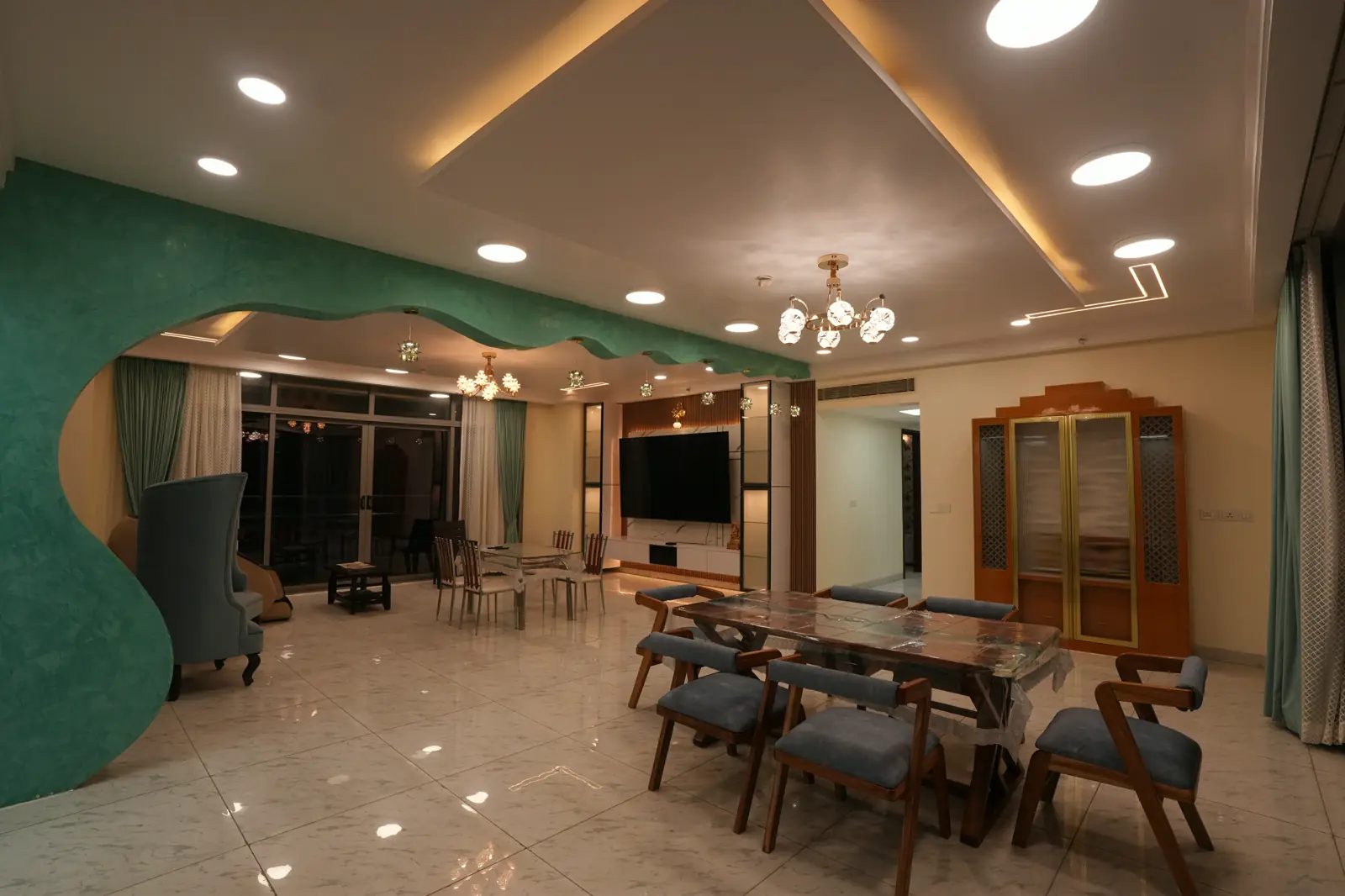
Living Room A turnkey approach lets the living room’s layout, lighting, media wall and seating be planned as one cohesive design, rather than furniture being added piecemeal after the civil work is done, which is where mismatched proportions and awkward electrical points usually come from. Bedroom Designing a Luxury Bedroom Through Turnkey Interior Design in Bangalore. A bedroom has more overlapping details than it looks: wardrobe layout, headboard and media wall design, lighting layers, and often a vanity or dressing area. Turnkey execution means the carpentry, electrical points and finishes for all of these are sequenced together from the start, so the wardrobe doesn’t get built before the wiring for a reading light is finalised, for instance.
Why Homeowners in Bangalore Prefer Turnkey Interior Designers
• Time pressure. Coordinating multiple vendors on a personal renovation takes real hours that a working household often doesn’t have to spare.
• Apartment handover timelines. Homeowners moving into newly handed over apartments often want the interior work completed on a predictable schedule.
• Owners who can’t be on site regularly need a team they can hold accountable remotely, without chasing multiple contractors themselves.
• Villa and full home projects. Larger homes have more trades to coordinate, which is exactly where a single accountable team matters most.
• Rising expectations on finish quality are pushing more homeowners to want design and execution held to the same standard, not just execution that technically works.
Is Turnkey Interior Design More Expensive?
It’s a fair question, and the honest answer is that it depends on what you’re comparing it to. If you compare a turnkey quote to only a designer’s fee, turnkey will look higher, but that comparison leaves out procurement, execution and vendor coordination, which you’d still be paying for separately either way. Compared to managing design and execution as separate contracts, turnkey often works out comparable or better once you account for:
• Fewer costly on-site corrections from design to execution mismatches.
• Less time and money lost to schedule slippage between uncoordinated vendors.
• No markup layered on by a middleman contractor coordinating designer specified work they didn’t plan. The more useful question isn’t “is turnkey more expensive” in isolation. It’s whether you’d rather pay for that accountability upfront, or absorb the cost of coordination gaps later.
Who Should Consider a Turnkey Interior Design Company?
Turnkey suits homeowners who:
• Are taking on a full home or villa scope project , not a single room refresh.
• Value one accountable team more than assembling the lowest quote from separate vendors.
• Have limited time to supervise a multi vendor site, whether because of work schedules or because they live outside Bangalore.
• Want design and execution held to the same standard , rather than a designer’s vision diluted by whoever ends up building it.
• Prefer cost and timeline certainty over the flexibility, and the risk, of managing each trade independently. If you’re doing a small, contained job and enjoy being hands-on with vendors yourself, a design-only or execution-only engagement may suit you better. Turnkey is built for people who want the whole thing handled.
Tips Before Choosing a Turnkey Interior Company
• Get the full scope in writing. Confirm exactly which of design, procurement, execution, and post handover support are included, not assumed.
• Ask how design is validated before construction. A firm that can show you how they catch issues before the build starts is different from one that simply promises “quality work.”
• Review past projects across similar scope. A firm that’s handled full home and villa projects will handle yours more predictably than one whose portfolio is mostly single rooms.
• Clarify the payment and timeline schedule. Understand what’s tied to which milestone, so there’s no ambiguity if a stage runs long.
• Confirm who you’ll be talking to day to day. Turnkey should mean one point of contact; make sure that’s actually how the company operates, not just how it markets itself.
• Check registration and compliance. A GST registered, compliant firm is a basic but meaningful signal, especially for larger budget projects.
When Should You Choose Turnkey Interiors?
Turnkey makes the most sense when:
• You’re furnishing a new apartment handover or a full home renovation , not a single room.
• You want to avoid coordinating multiple vendors yourself.
• You need the project to run on a defined timeline , because you’re moving in by a certain date.
• You’re not able to be on site regularly , whether due to work schedules or living outside the city.
• You want design decisions and execution quality to be the responsibility of the same team, rather than split across two.
Why Luxury Interior Designers in Bangalore Prefer the Turnkey Model
For high end residential work, the margin for error is smaller. Premium materials, custom carpentry and detailed finishes are far more expensive to redo than to get right the first time. Luxury interior designers favour the turnkey model because it lets them control quality end to end: the same team that specifies a bespoke finish is also the team executing it, so there’s no risk of a contractor substituting materials or missing a detail the designer intended. It also lets them commit to a firm timeline and budget on high value projects, which matters to clients who are investing significantly in their home.
Areas We Serve
Candidscape provides turnkey interior design and construction across Bangalore, with a strong focus on North Bangalore. Priority areas: RMV 2nd Stage, Sadashivanagar, Malleshwaram, MSR Nagar, New BEL Road, Hebbal, Yelahanka Also serving: Jayanagar, JP Nagar, Indiranagar, Koramangala, Whitefield, Sarjapur, Dollars Colony, Hennur, Thanisandra If your project falls outside these localities, get in touch. We take on additional areas across Bangalore depending on project scope.
Why Choose Candidscape Turnkey Interior Designers in Bangalore?
• One team across design and construction. Candidscape isn’t a design studio outsourcing execution; the same team handles interiors and construction, so there’s no handoff for quality to slip through.
• AI-validated design. Every design is digitally pressure-tested against the brief before construction begins, catching issues on screen instead of on site.
• Cross-sector discipline. The same structured process that’s delivered healthcare fit-outs and public-sector infrastructure applies to every residential project too.
• Track record. 73+ projects delivered since 2024, across residential, healthcare and commercial work.
• Registered and compliant. GST registered and compliant under Karnataka Shops & Establishments.
Frequently Asked Questions
Is turnkey interior design more expensive than hiring separately? Not necessarily. It can look higher if you’re only comparing it to a designer’s fee, but once you factor in procurement, execution and coordination, costs you’d bear either way, turnkey is often comparable, and it removes the cost risk of design to execution mismatches. How long does a turnkey interior project take? Timelines depend on the scope of the project and site readiness. A defined schedule is agreed during the costing and contract stage, before execution begins. Does turnkey include construction, or only interiors? It depends on the provider. Candidscape’s turnkey service covers full interior execution, and can extend into residential construction where the project requires it, since both are handled by the same team. What is the difference between turnkey and design-and-build? The two terms overlap but aren’t identical. “Design-and-build” describes who delivers the project: one team responsible for both design and construction, rather than separate firms. “Turnkey” describes what you receive: a fully finished, ready to use space handed over at the end. A design-and-build team is what makes a genuinely turnkey experience possible; because Candidscape designs and constructs under one roof, we can commit to handing over a space that’s truly ready to walk into. What is turnkey interior design in simple words? It means one company handles your entire interior project, design, materials, execution and styling, and hands you a fully finished space, so you don’t have to manage separate vendors yourself. Is turnkey suitable for small homes and apartments, or only villas? It suits both. The scale of coordination is larger for villas and full homes, but apartments benefit from the same single point of accountability approach, especially for new handovers on a timeline. Can I customize the design in a turnkey model, or is it fixed? Turnkey doesn’t mean fixed or catalogue based. Design is built around your brief and preferences from the consultation stage onward; turnkey refers to how the project is delivered, not a constraint on customisation. Does turnkey include furniture and styling, or only civil work? A genuine turnkey package includes furnishing and styling as part of the handover, not just civil and carpentry work. It’s worth confirming this explicitly in the scope before signing, since some providers use “turnkey” more loosely.
Ready to Discuss Your Project?
If you’re planning a full home interior project in Bangalore and want one accountable team handling design through to handover, get in touch with Candidscape for a consultation. [Start a Project →]